- Licensed and insuredCertificates of insurance on request
- Salt Lake area yardQuote, delivery, setup, servicing and pickup
- Every county in UtahWasatch Front to St. George and the Basin
- Heated and cooledBuilt for January snow and July heat
How renting works
- 1Call or send the planner with the town, dates and headcount.
- 2A quote comes back, usually the same working day.
- 3We deliver, level and set up; call the same line for service.
- 4Scheduled servicing on site, then pickup when the job ends.
Two configurations, and what each one is for
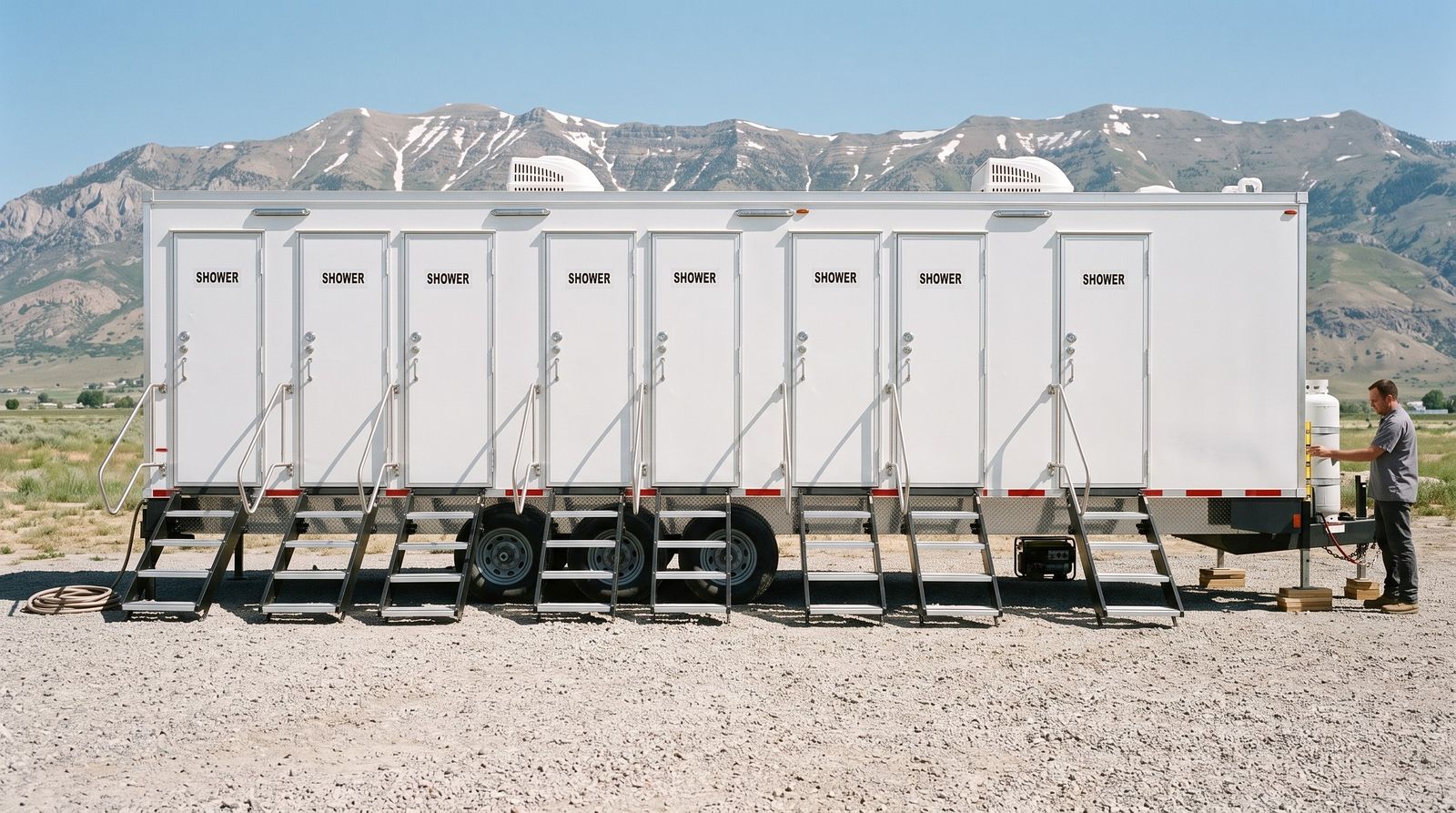
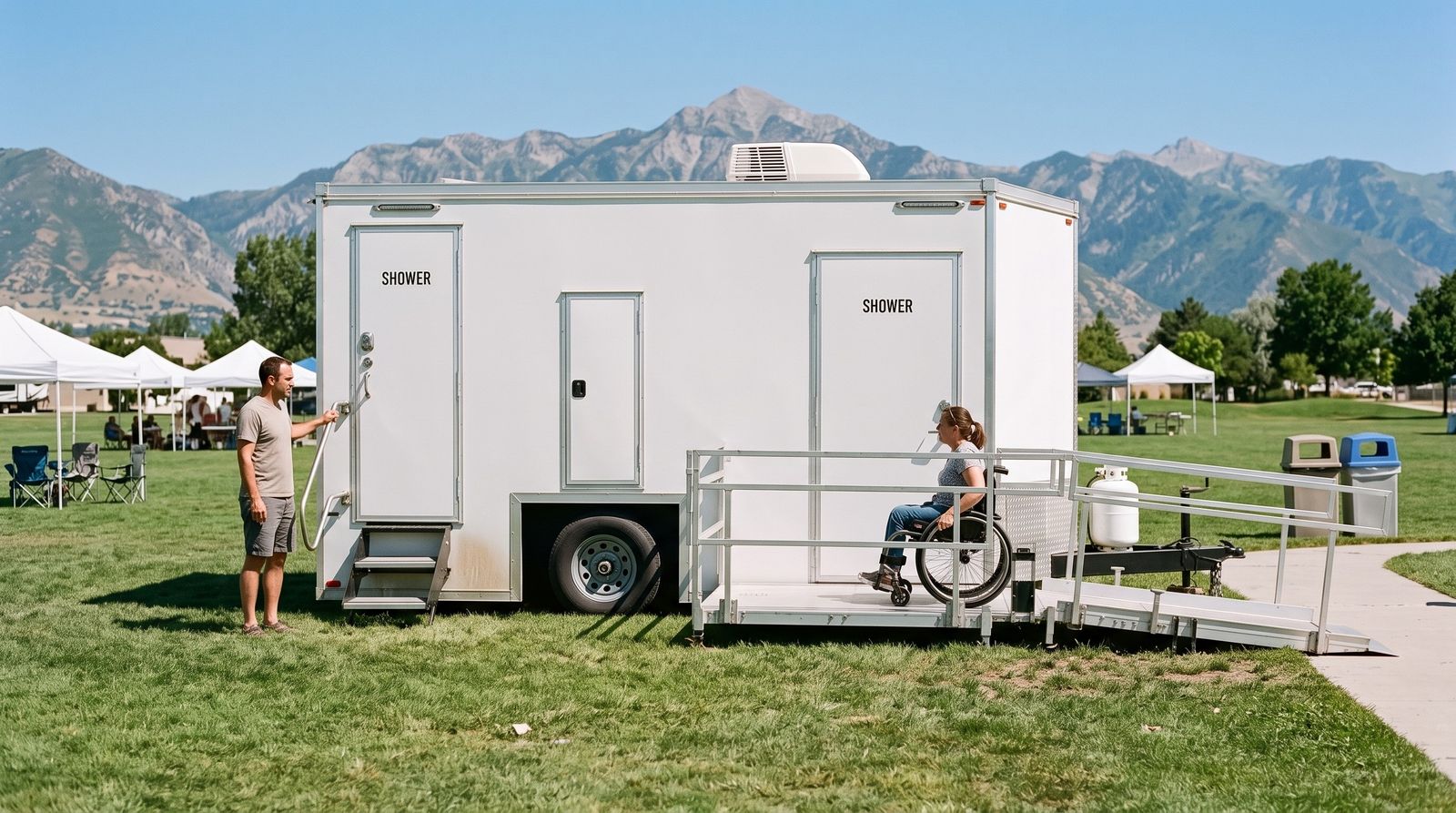
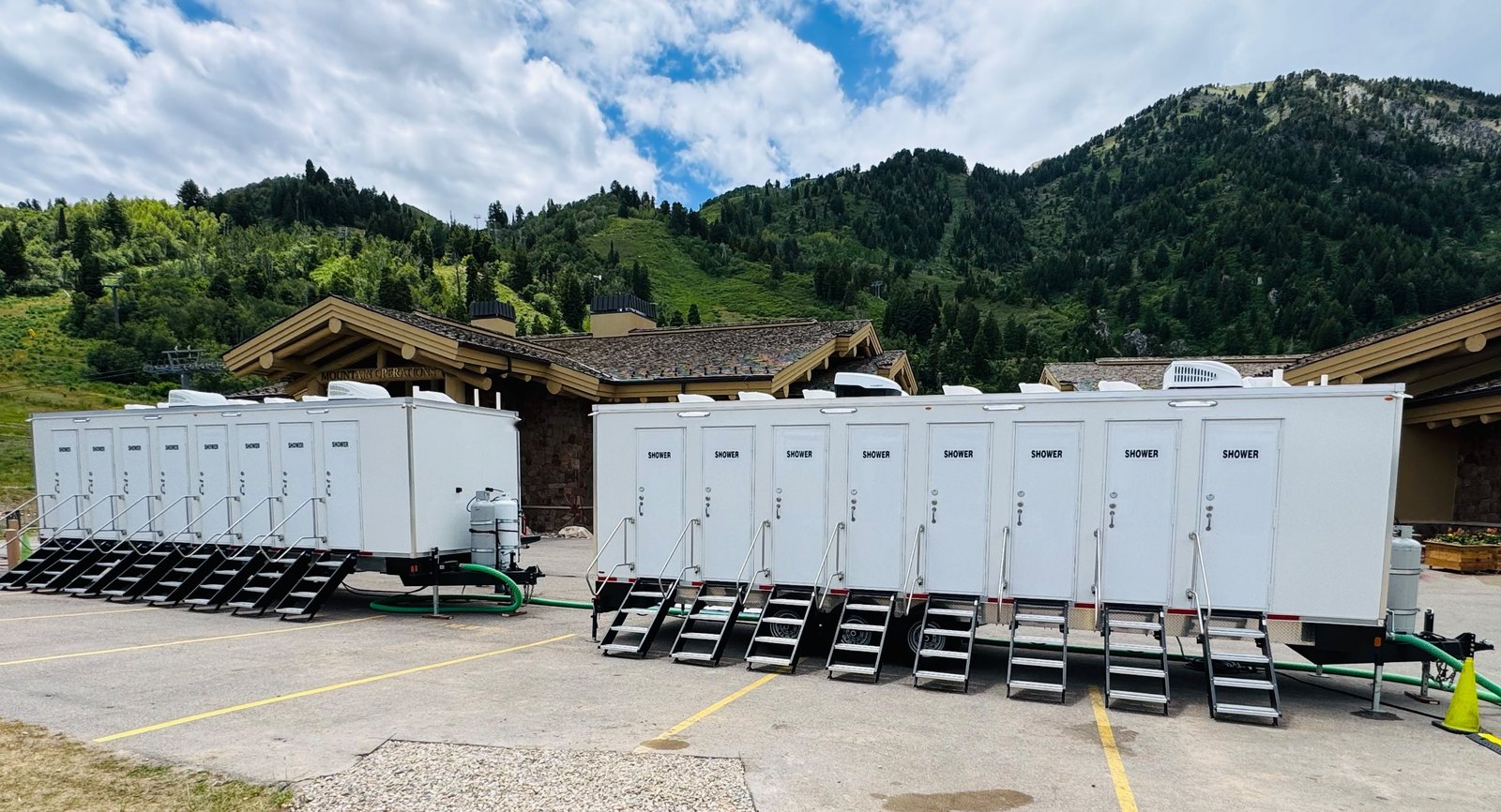
There are two shower trailer builds in regular use here. The larger one carries eight private shower rooms, each with its own exterior door. The smaller one is an accessible build: one shower room laid out to the accessible standard plus two standard rooms alongside it. Almost every job in this state is answered by one of those two, or by both of them parked next to each other.
The eight room unit exists for throughput. Its whole reason for being is the moment when a crew comes off shift together, or a race finishes, or a camp turns its whole cohort loose at once. Eight doors means eight people are in the water at the same time and the ninth is waiting a few minutes rather than an hour. Nobody is standing in a line that they can see the end of, which is the thing that quietly kills usage on a job site.
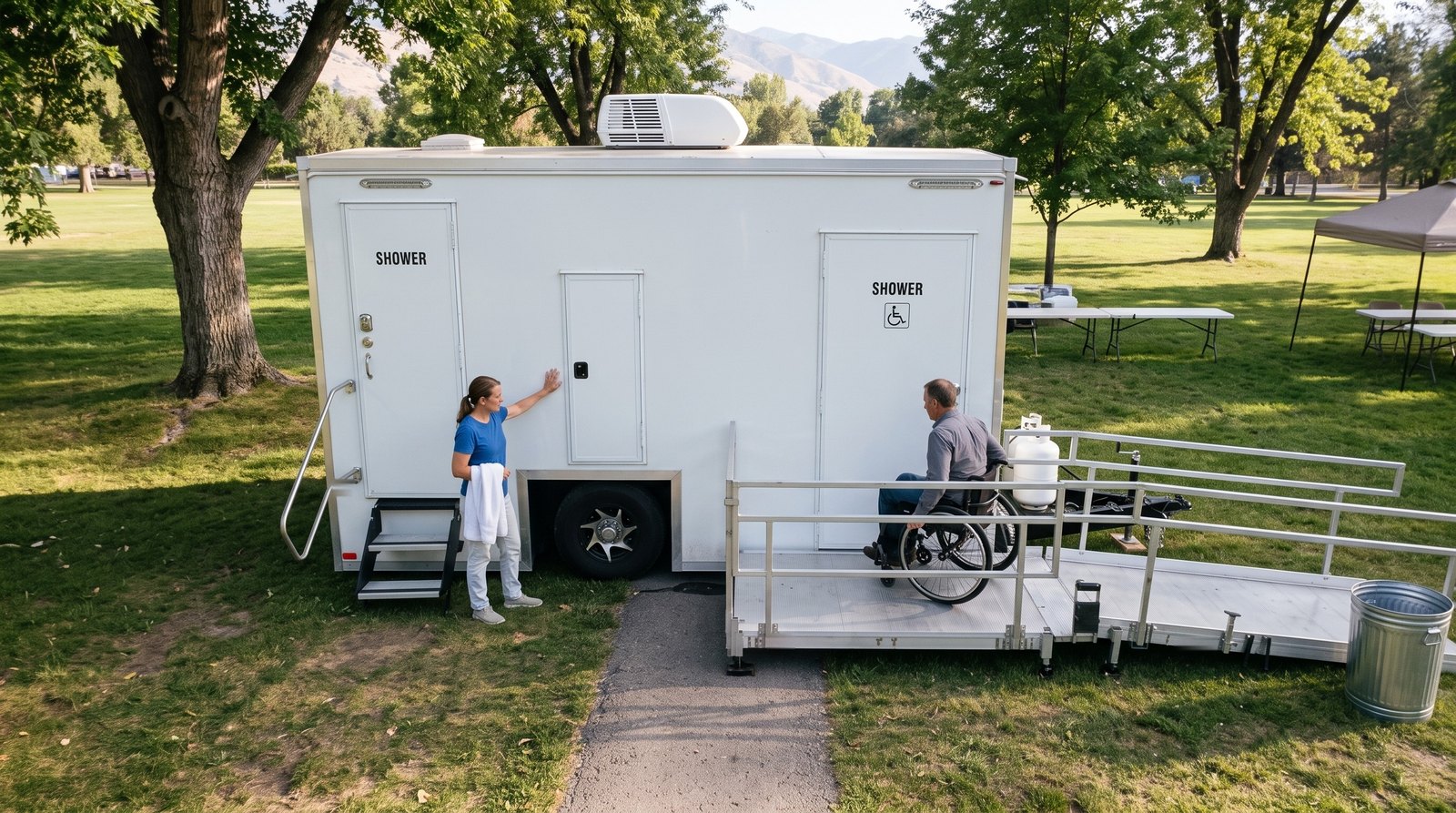
The accessible unit exists because a cluster of temporary units at a site or event has to include an accessible one, and because retrofitting a standard stall after the fact does not produce a room anybody can actually use. The accessible room is built as an accessible room from the frame up, with wheelchair turning space designed in. The grab bars are anchored into structure rather than screwed to a wall panel, and you get in by a ramp rather than a set of steps. The two standard rooms beside it make the unit useful as a small standalone trailer as well as a companion to the larger one.
The pairing comes up more than people expect. A wedding venue outside Heber City with a hundred and forty guests and one accessible requirement is a small unit on its own. A highway crew of thirty on a long placement near Lehi is the eight room unit on its own. A multi day event with a public crowd is usually both, because the accessible obligation applies to the cluster and the throughput requirement applies to the peak hour, and those are two different problems that want two different answers.
What one shower room actually contains
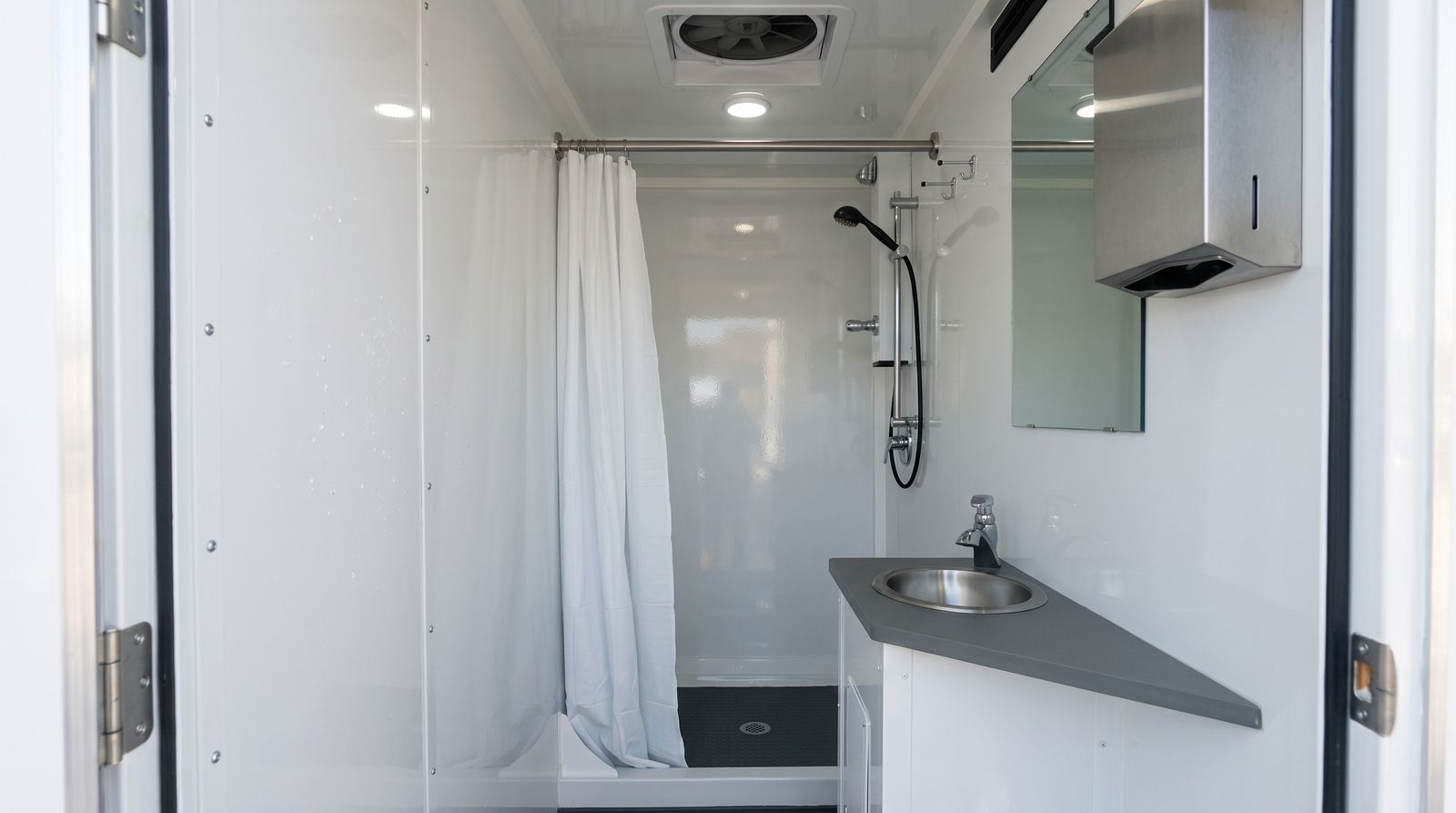
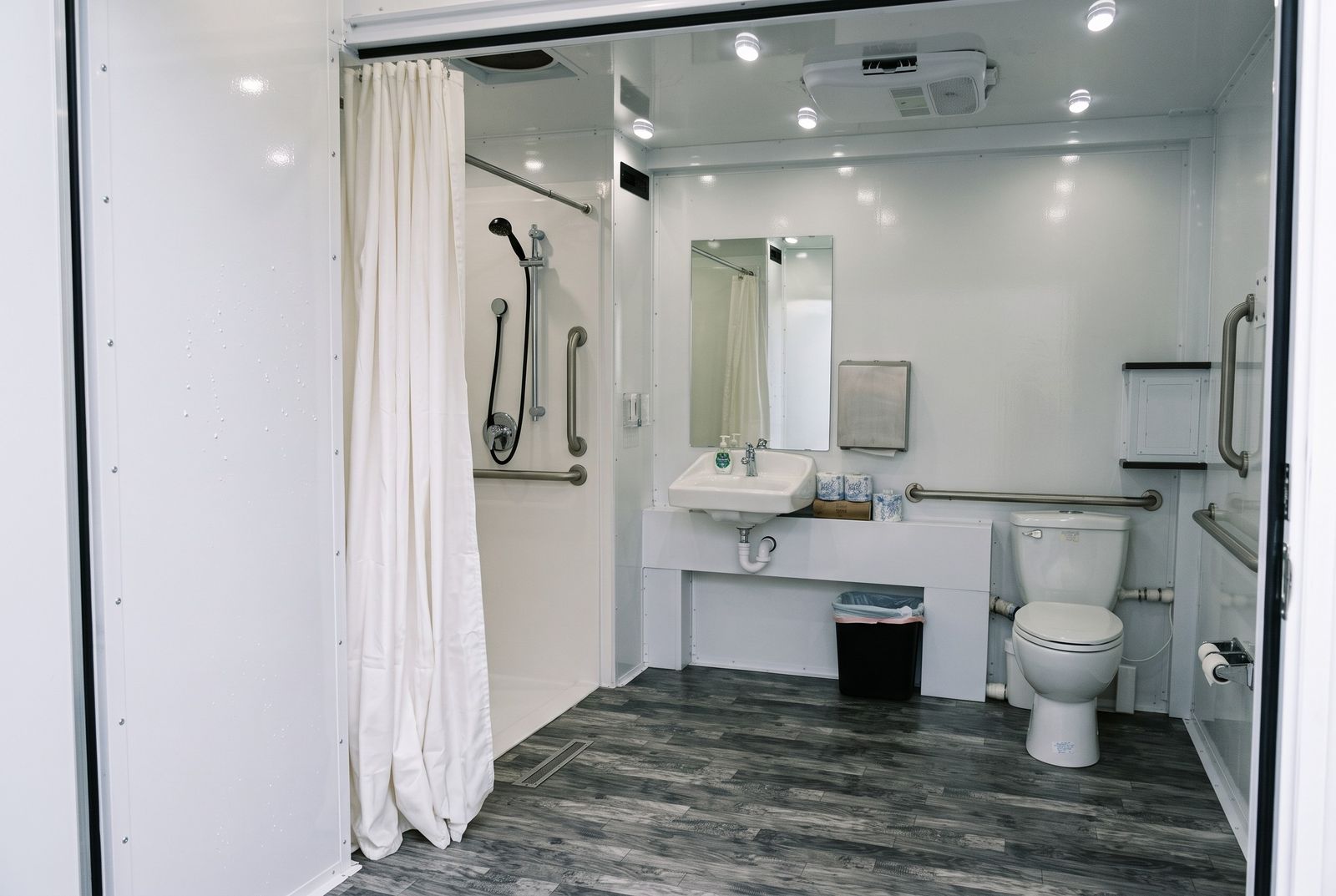
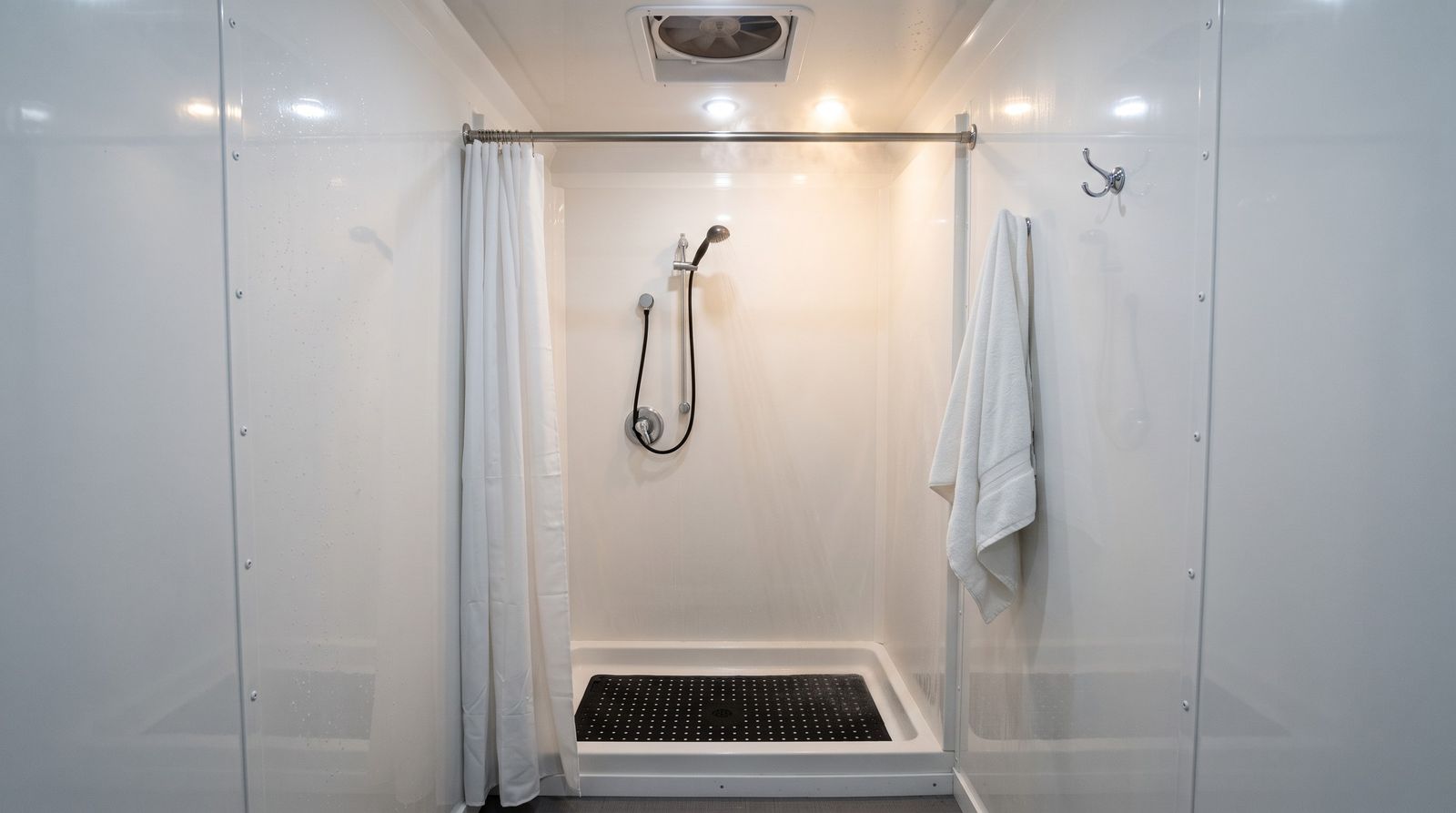
Each room is a finished, enclosed space with its own door that locks from the inside. Step in and there is a dry area first, then the shower itself behind a curtain or a partition depending on the build. The dry area is not an extra. It is where the bag goes, where the towel hangs, where somebody gets dressed without standing in standing water and without putting clean clothes on a wet bench.
There is a hook set high enough to keep a jacket off the floor, a shelf or ledge for soap and a phone, a mirror, and a light that is actually bright enough to shave under. A film crew going to camera in Moab and a wedding party getting ready in Midway both need to see what they are doing. So does somebody who has come off a dusty shift and wants to know whether their face is clean before they drive home.
The floor is a sealed surface with a drain that is pitched to it, not a flat pan that pools. The walls are a continuous surface rather than a set of panels with seams that trap water. That matters less on a two day event and a great deal on a placement that runs eight months, because seams are where a unit starts to look tired long before anything actually fails.
The difference between this and a row of standard portable units is not decoration. It is whether people use the thing. A crew that will not use a facility drives to a truck stop or goes home dirty, and then the rental was money spent on a box sitting on a pad.
Water warmed on the way to the showerhead
Water is heated on demand. It passes through the heater on its way to the shower head rather than sitting in a reservoir waiting to be used up. The practical consequence is that the tenth person gets the same water the first person got, which is not true of a stored tank system once the tank is drawn down.
On demand heating has its own limit, and it is worth being honest about it: the constraint is flow rate, not volume. A heater can raise a certain number of gallons per minute by a certain number of degrees. Ask it to serve more showers at once than it was sized for and the water does not run out, it runs cooler. This is why the unit gets matched to the peak hour rather than to the headcount, and why the questions on the first call are about when people shower rather than how many of them there are.
Incoming water temperature is the other half of the sum, and in Utah it swings hard across the year. A fill drawn in July in Washington County arrives warm and the heater barely has to work. The same fill drawn in January along the Wasatch Front arrives close to freezing, and the heater is being asked to lift it thirty or forty degrees further than it was in summer. That is real, and it is why a unit that felt limitless in August can feel tight in February if nobody accounted for it. Before a cold weather delivery we confirm the recovery rate against the expected inlet temperature rather than assuming the summer number holds.
Elevation moves it again. Gas fired water heaters are rated lower for altitude under the fuel gas codes, commonly around four percent of rated input for every thousand feet above two thousand feet, and water itself boils lower as you climb. A heater that performs one way on a valley floor around four thousand three hundred feet performs noticeably differently at Park City or Heber City elevation. Nobody notices this at a summer event. Everybody notices it at a February placement at seven thousand feet, which is why high country winter jobs get a heater sized with the altitude loss already built in instead of a heater that was fine last July in Orem.
Reviews of the trailers themselves
We needed an accessible room for a race weekend in Ogden. A wheelchair could turn around inside it, and the health inspector signed off the first time through.
Eight rooms for a 60 person crew on a Basin lease. The water heaters kept up through the whole evening rush, which is the only thing my guys care about.
Our film crew near Moab kept mentioning the dry place to change in each room. It was clean every morning and the air conditioning held through the afternoon.
What the unit draws, and what it draws it from
Two things dominate the electrical load: heating water and conditioning the cabin. Lighting, fans and pumps are a rounding error beside them. That is the whole shape of the power question, and it is why the answer changes so much with the season and the site.
Where there is shore power we use it, and what we need to know is what the circuit actually is rather than what is nearby. A construction trailer with a spare outlet and a dedicated circuit at the pad are two different situations. The failure mode when a unit shares a circuit with the rest of a site is not dramatic. Everything works until a cold January morning in Tooele when the site office and the shower unit both come on inside the same two minutes, and then the breaker goes and nobody knows why.
Where there is no shore power the unit runs on a generator, and the generator gets sized for the worst simultaneous case rather than the average. Worst case in July in the southwest corner of the state is air conditioning running continuously while water is being heated for a full rotation of showers. Worst case in January at altitude is cabin heat plus heat tracing plus water heating, which is the harder of the two. A generator picked for a shoulder season placement in Orem is frequently too small for the same crew in Washington County in July or on an exposed pad in Summit County in January.
Fuel is part of the plan, not an afterthought handed to the customer. On a self contained placement we build fuel runs into the service schedule alongside water and waste, because a generator that runs dry at two in the morning takes the freeze protection down with it, and that is a much more expensive problem than a fuel delivery.
Tanks, refills and pump outs
A self contained unit carries fresh water in one tank and everything that goes down the drains in another. Nothing is discharged on site. The shower and sink water goes into a sealed holding tank and leaves in a truck, which is a different regulatory animal from a permanent subsurface irrigation system and should not be confused with one. On any job where the disposal method is genuinely in question, the county environmental health division for that site is the right place to confirm it rather than a blanket statement from us.
Where there is a hose bib on site, the fresh tank gets topped up from it, so service visits can be spaced further apart. Where there is a sewer or septic connection, the waste side stops being a scheduling problem entirely. Most Utah sites have neither, or have one and not the other, and both of those are ordinary. The plan gets built around what is actually there.
Refill and pump out cadence is a function of usage, which means headcount multiplied by how long people shower multiplied by how many days between visits. A twenty person crew on a single shift near Fort Duchesne and a two hundred person weekend event in Midway generate very different numbers, and neither of them is well served by a default schedule. We work it out before delivery and then adjust it after the first cycle, because the first week always tells you something the estimate did not.
For permitted public events there is a floor underneath all of that. Utah's temporary mass gathering rule requires wastewater to be removed from units at least once every twenty four hours, and the local health officer can require it more often for heat, attendance or anything else they judge relevant. Private job sites are not under that rule, so their cadence is set by actual usage, which can be less frequent or considerably more.
On remote placements the deciding number is round trip distance to the nearest approved fill and dump point. A unit does not have to come back to the yard to be serviced. A permitted hauler can pump and fill in the field. What the distance changes is how much tank capacity we want on site so that a road closure, a storm or a washed out approach does not turn into a unit out of service.
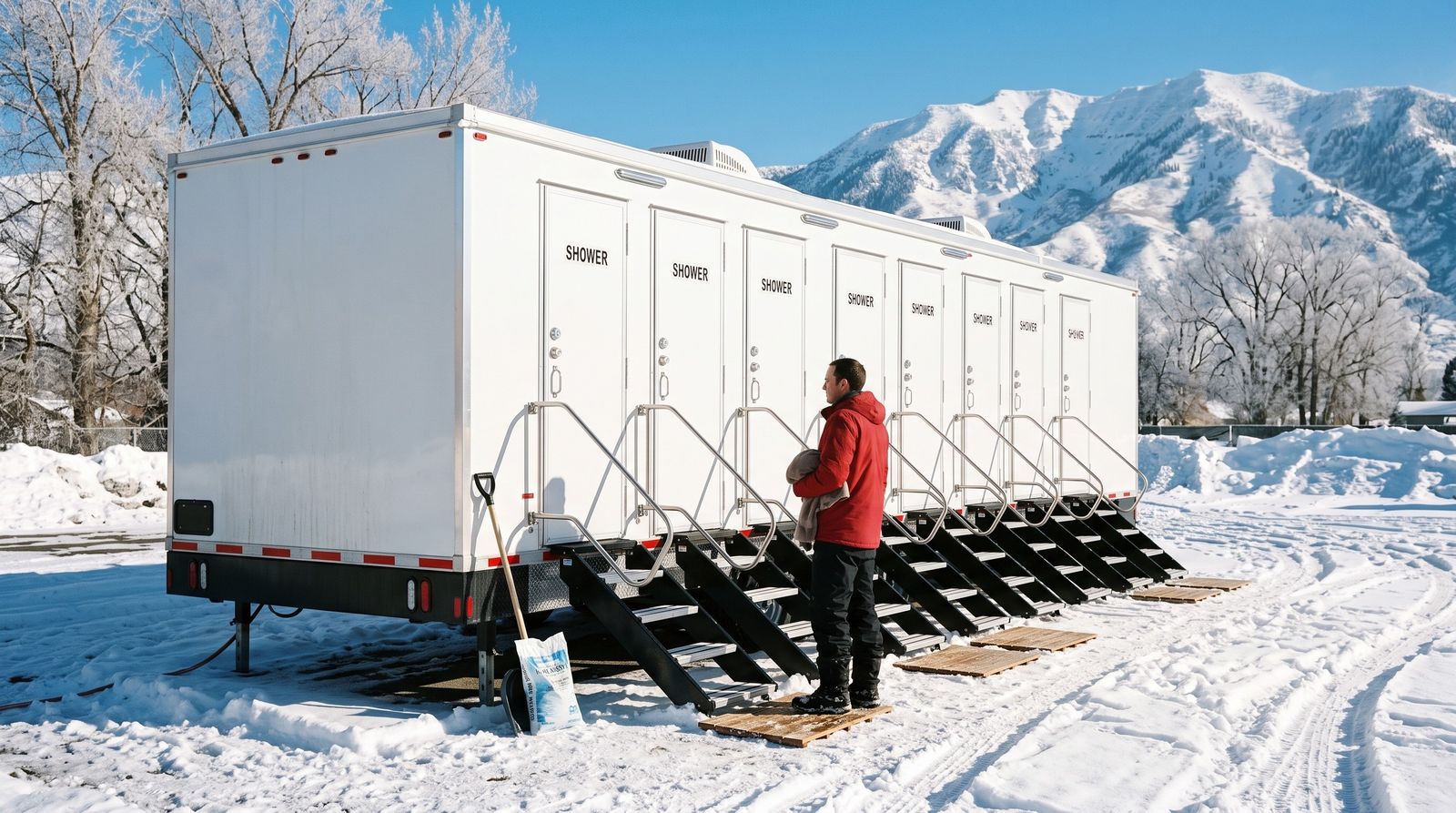
Freeze protection, and why it is the default here
Outside the immediate Saint George area, overnight temperatures drop below freezing routinely from about November through March, and in the mountain valleys that window opens in September and can still catch you in May. So cold is treated as the default condition for most of the year rather than a special order.
Freeze protection is several things working together, and missing any one of them puts the whole unit at risk. Plumbing runs are routed through heated space wherever the layout allows it. Runs that cannot be routed inside carry heat trace. The underside is enclosed so that the space under the floor is a buffer rather than an open wind tunnel. Tanks are insulated and heated. The cabin itself is held warm between users, which is about more than comfort: every line inside the cabin is protected by the cabin being warm.
Skirting the base is a cheap addition that does real work on an extended cold snap. It stops wind from stripping heat out from under the floor, which is the mechanism that actually freezes a unit that was otherwise set up correctly. On a winter placement anywhere above the valley floor it is worth doing on day one rather than after the first hard night.
Site conditions decide the rest, and they are the questions we ask before a winter delivery. Elevation, because the swing at seven thousand feet is not the swing at forty three hundred. Wind exposure, because a sheltered lot in Sandy and an open bench above Park City are different setups with the same equipment. Plowing, because a service truck that cannot reach the unit is the same as no servicing at all. And power, because every piece of freeze protection listed above runs on it.
Winter servicing also runs earlier in the day on purpose. Nothing gets left holding water into a cold night if we can help it, and a pump out at two in the afternoon and one at seven in the evening are not equivalent operations in February in Coalville.
Summer in the southwest corner is its own problem
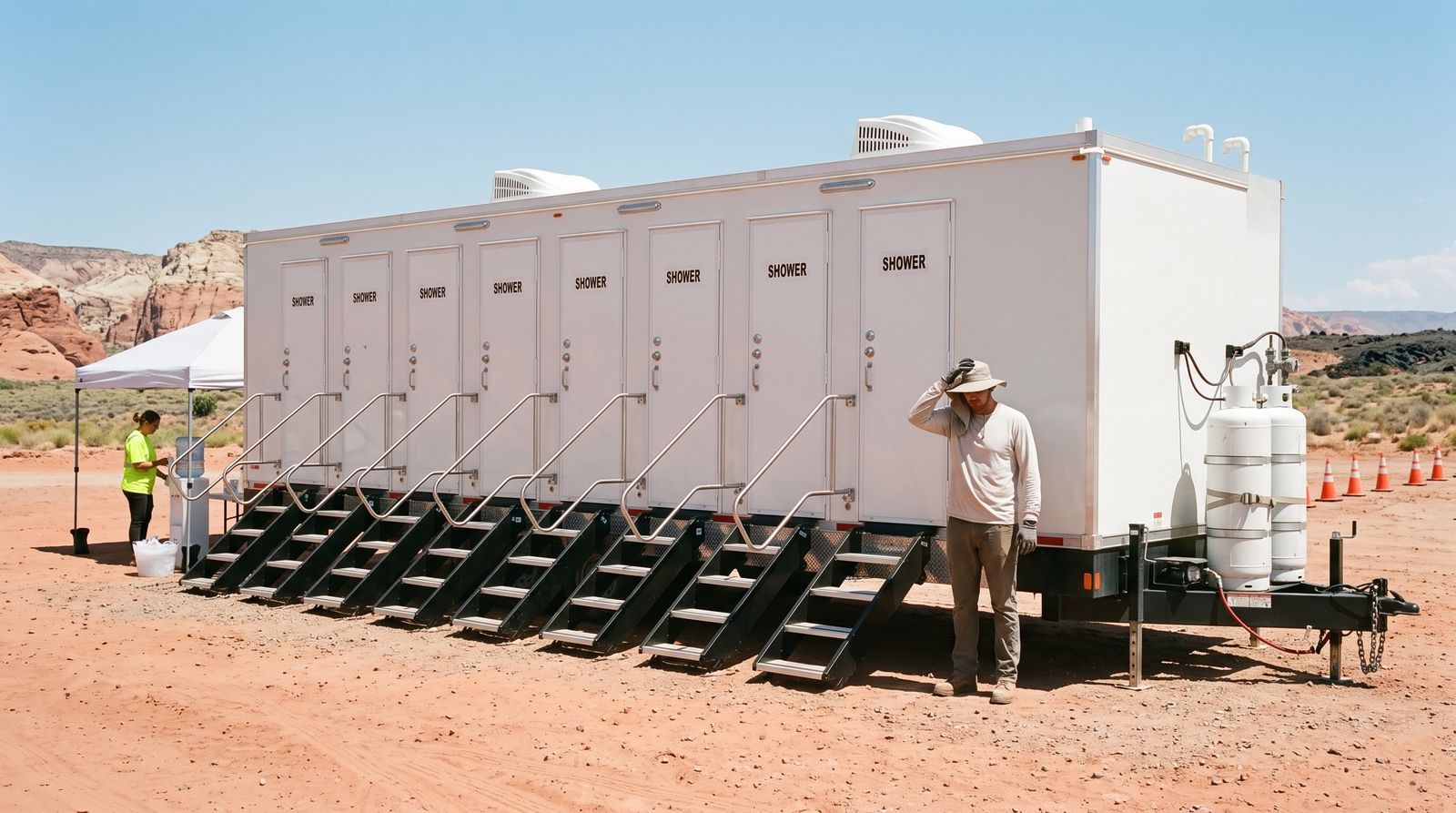
July and August highs around Saint George and Ivins run into the hundred to hundred and five range. At that point air conditioning stops cycling and simply runs, which changes the electrical load, and water turnover climbs because people shower more often and for longer. Both sides of the schedule tighten at once.
A cabin that becomes an oven fails in exactly the same way a freezing one does. People stop using it. The unit sits on the pad looking fine and doing nothing, and the rental was wasted just as thoroughly as if the water heater had failed. So the cooling side gets the same planning attention in the south that the heating side gets in the north.
Orientation helps more than people think. A unit with its long side facing the afternoon sun works harder than the same unit turned ninety degrees, and shade from a building, a rig or a stand of trees is worth real capacity. On a red rock site with no shade at all there is nothing to hide behind, and the answer is planning the cooling and power for the full load instead of hoping.
Refill and pump out intervals in a southern summer should be assumed shorter than the same crew size would need on the Wasatch Front in spring or fall. That is not caution. It is the arithmetic of more showers, longer showers and more water moving through the unit every day.
The unit is half of it, the site is the other half
Under the 2010 ADA standards, where single user toilet or shower units are clustered at a site or an event, at least five percent of the units in that cluster have to be accessible, with a minimum of one regardless of how small the cluster is. A temporary event is held to the same floor as a permanent venue. There is no short duration exemption.
What the accessible unit provides is the room: turning space, fixture heights, grab bars mounted into structure, a door wide enough to get through, and an entry ramp instead of steps. That part travels with the trailer and is the same wherever it lands.
What the site provides is the route, and this is where accessibility is most often lost. An accessible room at the top of a ramp that starts in soft gravel is not accessible. The connecting path from the parking or gathering area has to be firm, stable and slip resistant, the ramp landing has to be level, and the grade has to be something a wheelchair user can actually manage. On a graded pad that is straightforward. On a ranch venue with a lawn and a dirt lot it takes planning, and it is much cheaper to plan it in the week before than to solve it on the morning of.
Raise the accessible requirement on the first call rather than the last one. It changes which unit we hold, where on the site the placement wants to be, and occasionally the whole layout of a public event.
Count shower minutes, not people
The most common sizing mistake is counting heads. Sixty teenagers at a camp near Heber City who shower across a whole evening put less load on a unit than twenty people off a single shift at an industrial site who all want hot water inside the same half hour. Same equipment, very different answer.
So the first question is the shape of the demand, not its size. One shift change is a spike. Two staggered shifts is two smaller spikes and is much easier to serve. A public event with rolling attendance spreads the same total across a long day and is easier again. A wedding is a spike immediately before the ceremony and almost nothing afterwards. Tell us the shape and the number falls out of it.
Duration matters too. A crew doing dusty, physical work showers longer than a crew doing inspection work, and a camp full of teenagers showers longer than either. None of that is a judgment, it is just planning. A longer average shower at the same headcount is the same load as a larger headcount at a shorter one.
OSHA's construction sanitation table is sometimes used as a sizing shortcut. It is worth being precise about what it does and does not say. That standard covers toilets, not showers: one facility for twenty or fewer workers, roughly one seat per forty workers up to two hundred, one per fifty above that. It is a useful ratio to have in mind, and it does not mandate showers on a construction site at all. Showers on a job site are a crew welfare decision or a client specification layered on top of the base sanitation rule, not something that rule requires. Where a job involves hazardous material exposure, other standards can trigger a decontamination shower requirement, and that is a genuinely different obligation that should not be blurred into this one.
Sometimes the honest answer is a smaller unit than the one somebody called about. Sometimes it is two smaller units rather than one large one, especially when the road in is county gravel or a canyon grade where a long trailer cannot make the turn. Placing a unit that reaches the pad beats selling a larger one that strands the service truck three weeks later.
Which build tends to go where
- Long crew placements. Highway work, data center builds, pipeline and well pad work, mine and quarry contractor crews. Eight rooms, a servicing schedule built around shift change, and freeze protection from October onwards. These are the placements where the service plan matters more than the delivery date.
- Weddings and private events. Usually the accessible build, sometimes both units if the guest count is high. The placement question is nearly always sight lines and the walk from where people are to where the unit is, because a trailer parked in the wrong spot gets used half as much.
- Races and endurance events. Eight rooms at the finish area, because a finish is the purest version of a spike. Remote trailheads and canyon start lines mean self contained operation and a water plan worked out from the road distance.
- Film and production base camps. Eight rooms, placed out of the shot and out of the wind, with call times driving the service window rather than the other way round. Production schedules move, and the servicing plan has to move with them.
- Camps and youth groups. Volume across a long evening rather than a spike, which is kinder on the water heater than it sounds. Elevation is usually the harder constraint, along with the road in.
- Renovations and outages. A gym, a care facility or a school with the hot water down. Often has power and water at the curb and no room to park, so the placement conversation is about access and the service conversation is about how long the outage really is.
- Response and incident support. Fire camps, flood and debris flow response after a burn scar event, anything standing up quickly. Fastest possible delivery, self contained, and a service cadence that gets revised as the camp grows.
None of those are rules. They are where each build usually lands, and a job that does not look like any of them is still an ordinary phone call.
Eight room and accessible shower trailers compared
Most calls end with one of two answers, so here they are next to each other. The table is the short version. The notes under it are where the real decisions get made.
| Question | Eight room unit | Accessible unit |
|---|---|---|
| Shower rooms | Eight private rooms, each with its own exterior door | Three rooms: one accessible, two standard |
| Accessible room | No | Yes, with an entry ramp and grab bars fixed into the frame |
| Built for | A peak, such as a shift change or a race finish | An accessible requirement, or a small group spread across the day |
| Power | Shore power on a dedicated circuit, or a generator | The same |
| Water and waste | Hookups where they exist, onboard tanks where they do not | The same |
| Placement | Needs a longer pad and a turn a long trailer can make | Fits tighter venue lots and narrower approaches |
| Often paired | With the accessible unit at public events | With the eight room unit when the crowd is large |
Read the rows as questions rather than specs. The first is how many people need hot water inside the same half hour. If the answer is more than a handful, start with the eight room unit, because eight doors keep a line from forming. A 45 person shift on a Tooele County warehouse build that comes off together at five thirty is exactly the load it was built for.
The second question is whether anyone in the group needs an accessible room. At a public event the answer is yes, because the requirement applies to the cluster of units on site. At a private job it depends on the crew, and it is worth asking before delivery rather than after. The accessible unit also stands on its own for small jobs. Think of a family reunion at a Bear Lake cabin, or a Logan care home where residents need one safe shower while the old bathrooms are torn out.
The third question is the ground. The eight room unit wants a longer, level pad and an approach a long trailer can turn into. The accessible unit is easier on a tight venue lot or a narrow ranch lane in Sanpete County.
Power and water read the same in both columns on purpose. Both builds run on shore power or a generator, and both run on hookups or onboard tanks, so the choice never comes down to utilities. It comes down to the peak, the accessible need and the ground, in that order. Bring those three answers to the call and the unit is usually settled in the first few minutes.
What happens on a service visit
A service visit is not just a pump out. The waste tank is emptied, the fresh tank is filled where there is no supply on site, every room is cleaned properly rather than wiped, supplies are restocked, and the mechanical side gets looked at while somebody is already standing there: heater operation, drain flow, thermostat behavior, the state of the seals and vents on a dusty site.
Frequency comes out of the usage plan and then gets corrected by reality. If the first cycle shows the waste tank arriving fuller than expected, the interval gets shorter. If it arrives half empty, it stretches, and the customer stops paying for visits that are not doing anything.
Dust drives its own schedule. On dirt ground in the west desert, on southern Utah sand, or on a lease road in the Uinta Basin, fine dust works into door seals, roof vents and fan openings over time. Keeping doors closed when the unit is not in use, and placing it away from the heaviest haul traffic where the site allows it, extends the interval between deeper cleans considerably.
Anything that needs attention between scheduled visits is a phone call, not a wait. Slow drainage, a drop in hot water, a thermostat nobody can work out, a service truck that needs a path cleared. A small problem on day one is cheap and a small problem on day four is not.
The road decides more than the mileage
A shower trailer is a long, heavy, road going trailer behind a truck. Everything about delivery follows from that. A site two hours away on pavement is an easier delivery than a site forty minutes away up a rough two track with a tight turn at the top, and the second one is where jobs actually go wrong.
What we want to know before delivery day: the surface and grade of the last mile, whether there is room to turn around or whether the truck has to back the whole way out, any weight restricted bridge or cattle guard on the route, anything low overhead, gate width, and whether the approach gets soft when it rains. A pin and a photo of the actual spot answer most of that faster than a description does.
The pad needs to be level, stable and load bearing. Gravel, compacted base, asphalt and concrete all work. Unimproved dirt often works and sometimes needs leveling material first, particularly the sandy soils common in the southern part of the state and the fine silt in parts of the west desert. Spring runoff, roughly March through May on the Wasatch Front and into June higher up, is the highest risk window for a placement that was fine in March and is a bog in April.
If the answer turns out to be that a loaded trailer cannot reach the spot you wanted, that is much better learned on the phone than with a truck waiting at the bottom of the grade. Frequently there is a second spot fifty yards away that works perfectly, and the whole problem goes away once somebody has walked it.
What this is being compared against
Most people arrive at a shower trailer after considering something else first, so it is worth laying the options side by side honestly rather than pretending there is only one answer.
A row of standard portable stalls is cheaper and it works for some jobs. What it does not do is produce a room people want to stand in for ten minutes. There is no dry area, no counter, no mirror worth using, no heat, no cooling, and no realistic way to keep it pleasant on day nine of a placement. On a two day event with a tolerant crowd that can be fine. On a long crew placement it tends to end with people not showering, which is the outcome the rental was supposed to prevent.
Sending people to a gym or a truck stop is the option nobody writes down but plenty of crews are quietly using. It costs the crew forty minutes each way at the end of a shift, it depends on a business being open when the shift ends, and it evaporates entirely on a remote site. It is also the reason a job that has never rented showers can still have a shower problem.
A plumbed temporary bathhouse, built on site and tied into utilities, is the right answer on a small number of very long projects where the utilities exist. It is a construction project rather than a rental, it takes weeks to stand up, and it cannot be moved when the site layout changes. Most Utah jobs that consider it end up not needing it, because the placement is measured in months rather than years and the site does not have the tie ins anyway.
The case for a trailer is narrower than a sales pitch would make it and stronger where it applies: when people need to shower somewhere there is nothing, when they need to keep doing it for longer than a weekend, when the weather is going to be extreme in one direction or the other, and when usage rather than presence is the thing being bought.
Take the shower trailer walkthrough
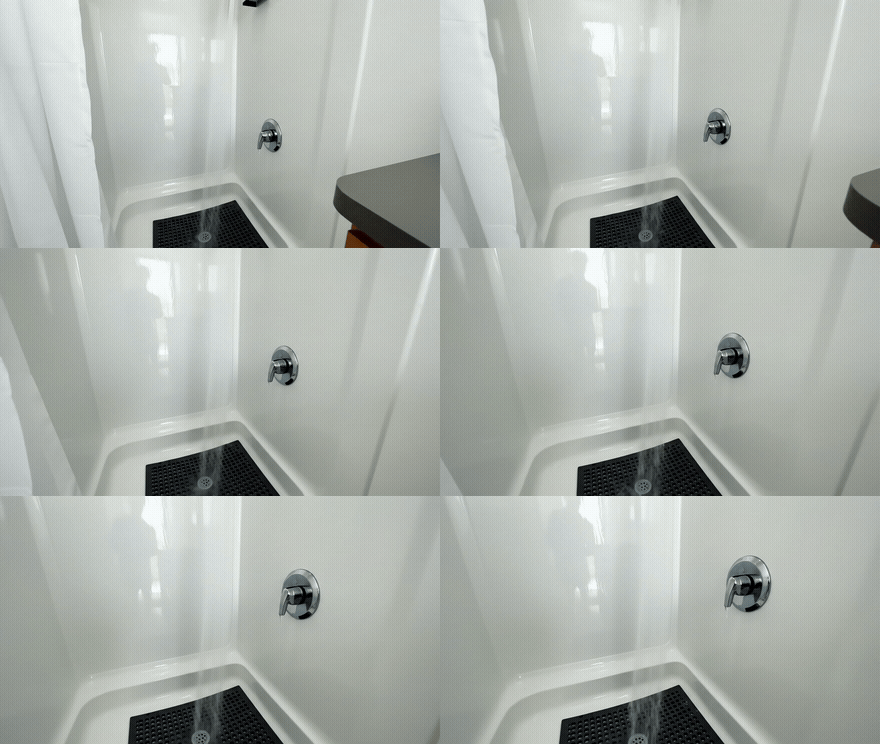
A short loop inside one of the rooms: the stall, the mixing valve and the finish work. If you are weighing a shower trailer against a row of standard portable units, this is the difference, and it is easier to see than to describe.
A short loop inside one room