
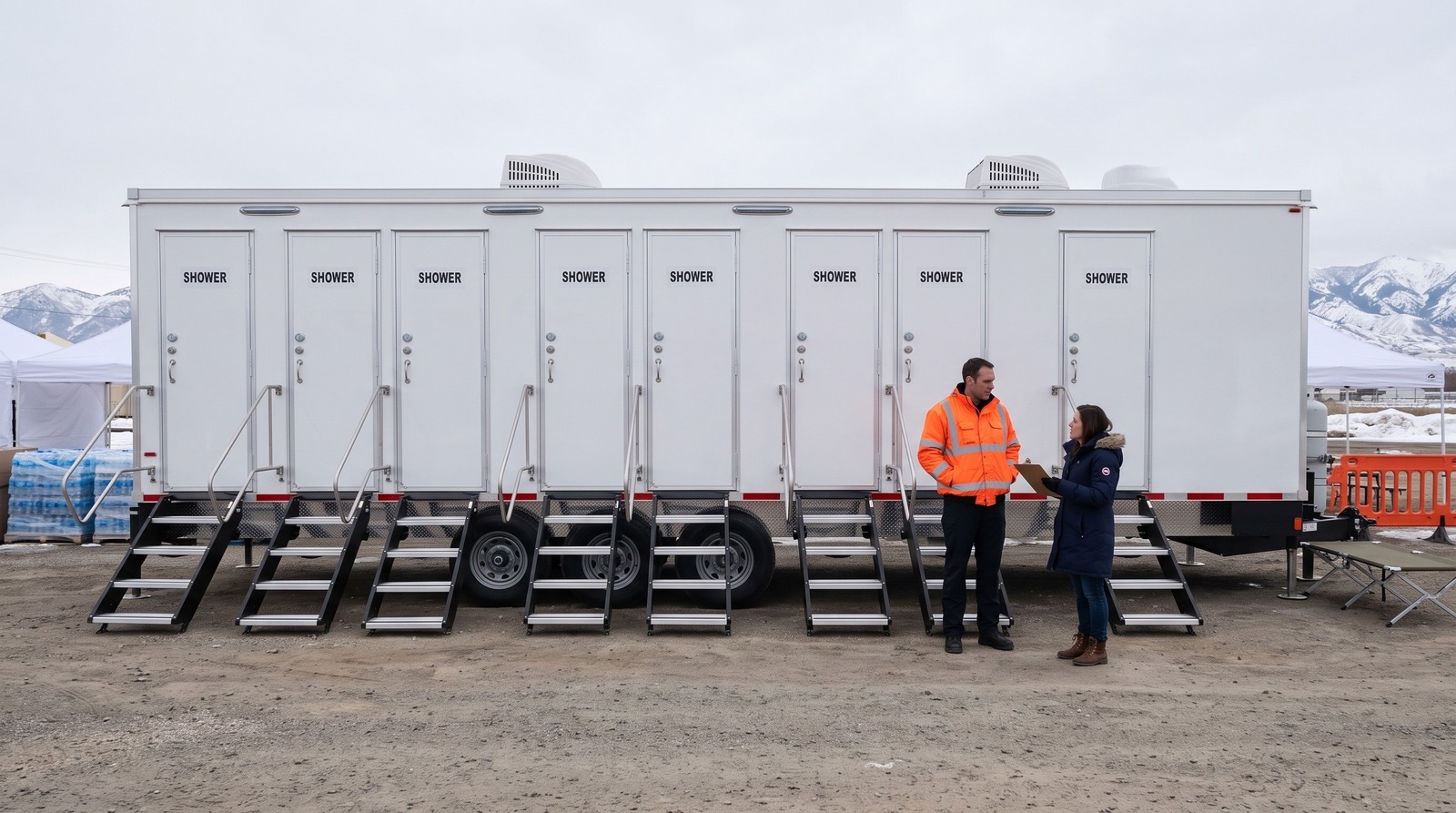
- Licensed and insuredCertificates of insurance on request
- Salt Lake area yardQuote, delivery, setup, servicing and pickup
- Every county in UtahWasatch Front to St. George and the Basin
- Heated and cooledBuilt for January snow and July heat
How renting works
- 1Call or send the planner with the town, dates and headcount.
- 2A quote comes back, usually the same working day.
- 3We deliver, level and set up; call the same line for service.
- 4Scheduled servicing on site, then pickup when the job ends.
Write the job down here, or ring the same desk
If a phone call does not fit your day, fill this in. It goes to the same people who answer the line, with the same questions a call would cover.
It reached the desk
Dispatch has it now and will come back by phone or email with the unit that fits and any question about the site.
If the dates move before you hear back, ring (801) 683-5822 and tell whoever answers.
- Phone
- (801) 683-5822
Quotes, scheduling and service calls, all on one line. - When the desk answers
- A request that lands while the desk is staffed normally gets a reply that day. One sent after hours is first in line the next morning. A service call on a unit already on site goes ahead of new bookings.
- Service area
- Every county in Utah, delivered and serviced from a Salt Lake area yard.
- Prefer a full page
- The Utah shower trailer rental planner page has the same form with notes on what to have ready.
One number, and it goes to the people who schedule trucks
(801) 683-5822 is the fastest way in, and the planner above lands on the same desk. It is the line for a job starting next season and the line for a building that lost hot water this morning. It is also the line for a unit already sitting on your pad that is doing something you did not expect.
There is nothing to navigate. A person answers, and if they are out on a site when you ring, leaving the town, the dates and a callback number is enough to get a useful return call rather than a request to start over.
Voicemail is read the same way an email is. Town, dates, roughly how many people, and the best number to reach you. That is enough for the callback to begin with an answer instead of a questionnaire.
The desk that quotes your job also knows the road to it
The person on the phone handles this state. They are not reading from a national script and they are not going to call somebody back to find out whether a canyon route works. They can tell you whether the last mile to your site is a problem, roughly how many rooms a crew of your size and shift pattern actually needs, and what a winter placement at your elevation involves that a summer one does not.
That means most questions get settled on the first call rather than deferred. Sizing, availability, what the site needs ready, whether the accessible unit is the right answer, what the service cadence would look like at that distance. The things that genuinely cannot be settled on a call are usually about the last quarter mile of access, which is why a pin or a photo is worth more than any amount of description.
It also means you are talking to somebody who will still know your job on the third call. Nothing in the conversation has to be repeated because the file moved desks.
How a first call usually goes
The call has a shape, and knowing it in advance makes it shorter. It opens with where, because location decides almost everything downstream. Then when, then who is using it and in what pattern across the day. Then the site: power, water, waste, surface, access. Then anything unusual. That is the whole thing, and on a straightforward job it takes a few minutes.
Location is not just a town. It is a town plus how a truck gets to the specific spot. A paved yard in Sandy, a sloping pad above Midway and a rough lease track in the Basin all fit the same one line description and none of them are the same delivery. If you have a map pin or a photo of the actual ground, send it during or after the call and the access question is answered in seconds rather than discussed for ten minutes.
Dates are a range rather than a commitment, and that is fine. Schedules in this state slide, usually around weather, and a window that is still moving is not a problem as long as everyone knows it is moving. What is harder is a date presented as fixed that was never fixed, because then the equipment is held against the wrong week.
Headcount is the question people expect and the shape of the day is the question that actually matters. Sixty people showering across a whole evening and twenty people arriving in the same half hour are different jobs at the same headcount. A shift change is a spike. A rolling public event is a long plateau. A wedding is a spike immediately before the ceremony and near silence after it. Describe the shape and the sizing follows.
Then the site questions, which are the ones that most often need a second look before they can be answered. What the electrical supply at the spot really is, and what else draws on it. Whether there is a hose bib, a hydrant, a sewer or septic tie in, or nothing at all. What the surface is and what it does when it rains. Any of those answers is workable. It is only the guess presented as a fact that causes trouble.
What people say about calling the desk
I called with half the details missing and still had a plan and a delivery date by the end of the first call. A real person picked up.
Our water heater went out and staff needed showers the next day. One afternoon phone call, and a trailer was set up and running by the following morning.
Needed to extend by a week at the last minute. One call and it was done, and nobody tried to sell me anything I did not need.
Four things that are usually taken on trust and should not be
- That the headcount is the load. A number of people is not a load until you know how they arrive. Forty across an afternoon and forty inside twenty minutes are not the same job, and the second one is the one that gets sized too small. Work out whether your number is a total or a peak before you quote it to anybody, including us.
- That there is power because there is a socket. An outlet proves almost nothing. What matters is what shares the run with it and what comes on at the same time in the morning. This is the most common cause of a nuisance trip on a working site, and one question at the start avoids it entirely.
- That the approach stays the way you last saw it. Ground that carried a pickup in August will not necessarily carry a loaded trailer in April, and a track that drained fine in a dry week behaves differently after a storm. Somebody who has walked it recently, in weather like the weather you expect, is worth more than a satellite view.
- That somebody will be around on the day. A delivery with nobody you can reach turns into guessing about where the unit goes and no one to hand the unit to at the end. It does not have to be the person booking, but it has to be a person, with a number that gets answered.
None of those need research. They need one person on your side to check rather than assume, and checking them is the difference between a quote that holds and a quote that gets revised on delivery morning.
Call anyway and say which parts are unknown
Most people renting this equipment have never rented it before, and a good share of first calls arrive with half the answers missing. That is completely ordinary and it is not a reason to wait until you have done homework.
An unknown marked as an unknown is useful information. It tells us which part of the plan has to stay flexible and which questions to put to the site contact before delivery. An unknown presented as a certainty is the thing that produces a truck at the bottom of a grade it cannot climb.
Some of the questions genuinely cannot be answered by the person booking. A venue coordinator frequently does not know what circuit is at the back of the property. A production manager does not always know what the access road does when it rains. Say so, and we will either ask the site directly or plan around not knowing, which usually means carrying more capacity and fewer assumptions.
If you are early enough in planning that you are really asking whether this is the right equipment at all, that is a fine call to make too. Sometimes the honest answer is that a smaller unit covers it, and occasionally it is that what you actually need is not a shower trailer.
Same day and overnight deliveries
Some calls cannot wait for a form. A care facility whose boiler died overnight with a full census depending on it. A fire camp that doubled between shifts. A school gym turned into a staging point at a few hours notice. A crew whose site services were cut off by a contractor error.
Ring for those. You will get a straight answer about what can actually be on the road and when, including when the answer is that a unit cannot be there as fast as you need. A real time you can plan around beats an optimistic one that slips, and on an urgent job the difference between those two is the difference between a solved problem and a worse one.
Distance is the honest constraint on urgent work. A same day answer in the valley is frequently yes. The same request for a site past Moab, out beyond Goshen or deep in the Basin involves a drive that has to be said out loud rather than skipped over. We would rather name the hour and hit it.
On urgent placements the plan gets simplified deliberately. Self contained operation, a generator if power is uncertain, more tank capacity than the headcount strictly requires, and a service cadence that is revised after the first cycle once the real usage is visible. Getting a working unit on the ground beats optimizing one that arrives late.
Short notice that is not an emergency
Short notice is worth a call even when it feels too late, because availability moves through the week rather than being fixed on Monday. Units come back to the yard, jobs finish early, a placement gets pushed by weather and frees a unit that was committed. A no on Tuesday is genuinely sometimes a yes on Thursday.
What helps a short notice request most is flexibility on the part that is least important to you. If the delivery day is movable by twenty four hours, or the unit can go on the far side of the site, or a smaller build would cover it, say so at the start. Those are frequently the difference between fitting a job in and not.
What does not help is a request that is short notice and also missing the site answers. On a normal timeline we can chase the missing answers, but inside a week there is no time to, so the job either goes in on best guesses with margin built in, or it does not go in at all.
Spring through autumn is when short notice is hardest, because construction season and wedding season overlap along the Front and the fixed calendar weekends concentrate demand sharply. Winter has its own crunch points around resort and holiday dates. In the shoulder weeks there is usually more room than people assume.
Delivery drive times from the Salt Lake yard
How fast a unit can reach you depends mostly on the road, so these are the numbers dispatch works from. They are highway times from the yard in good weather, in a car. A truck towing a loaded shower trailer is slower, and canyon grades and winter storms slow it more.
| Where the site is | Highway time | Short notice, realistically |
|---|---|---|
| Sandy, West Jordan, Draper | 20 to 40 minutes | Same day is often possible |
| Ogden and Layton | About 40 minutes | Same day is often possible |
| Lehi, Orem and Provo | 30 to 50 minutes | Same day is often possible |
| Park City and Heber City | 35 to 50 minutes over Parleys | Same day in good weather, slower in a storm |
| Logan and Cache Valley | About an hour and a half | Usually next day |
| Price and Carbon County | About two hours | Usually next day |
| Vernal and the Uinta Basin | About three hours, more on lease roads | Next day, with the hour named |
| Cedar City | About three and a half hours | Next day, with the hour named |
| Moab and St. George | About four hours | Next day, with the hour named |
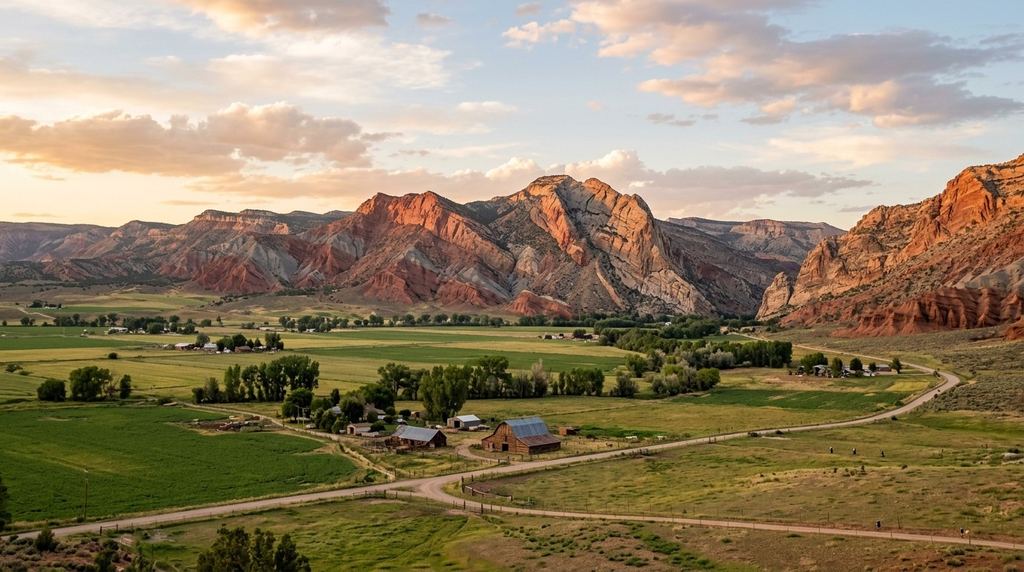
The short notice column is the honest part. Same day in the valley depends on a unit being in the yard, and it often is, because units come back from jobs all through the week. Past about two hours out, the drive itself eats most of a working day. A request that lands at noon for a site near Vernal turns into a morning delivery the next day, and we would rather say so on the first call than promise the afternoon and miss it.
Replies follow the same logic. A call to (801) 683-5822 reaches the desk directly. A planner request that arrives while the desk is staffed gets an answer that day, and one sent overnight is first in line the next morning. A service call on a unit already on site goes ahead of new bookings, because a unit that stops working is costing somebody a shift.
For planned work, none of this matters much. Book two weeks out and shower trailer delivery to St. George gets the same morning as a site in Draper. It is only on short notice that the map starts to count.
Booking a season ahead
Anything on a known date wants to be booked well ahead of it, and this is less about us than about how demand concentrates in this state. Fair weeks, race weekends, festivals and the big fixed events pull regional demand onto specific weekends, and on those weekends the constraint is availability rather than distance or difficulty.
Long placements are a different planning exercise. A multi month crew position, say a pipeline crew on a Uinta Basin lease outside Vernal (the crew shower trailer guide covers that kind of job), is planned around the service schedule first. Where there is no shore power we add a fuel plan, and we ask for one named contact on your side who will be there for the duration. Tell us the length and we will plan the servicing around it rather than quoting a delivery and improvising the rest.
Seasonal work that crosses a boundary needs saying out loud. A placement that starts in September and runs to March starts as an ordinary job and becomes a winter job halfway through, and the freeze protection, the skirting and the snow clearing plan have to be in place before the weather arrives rather than after the first hard night.
For events specifically, there is a second clock running that is not ours. County health department permitting for a public gathering generally expects an application at least thirty calendar days ahead to avoid a late fee, and the permit process is separate from booking equipment. Starting both at the same time avoids the situation where the trailers are confirmed and the paperwork is not.
When the planner is the better route
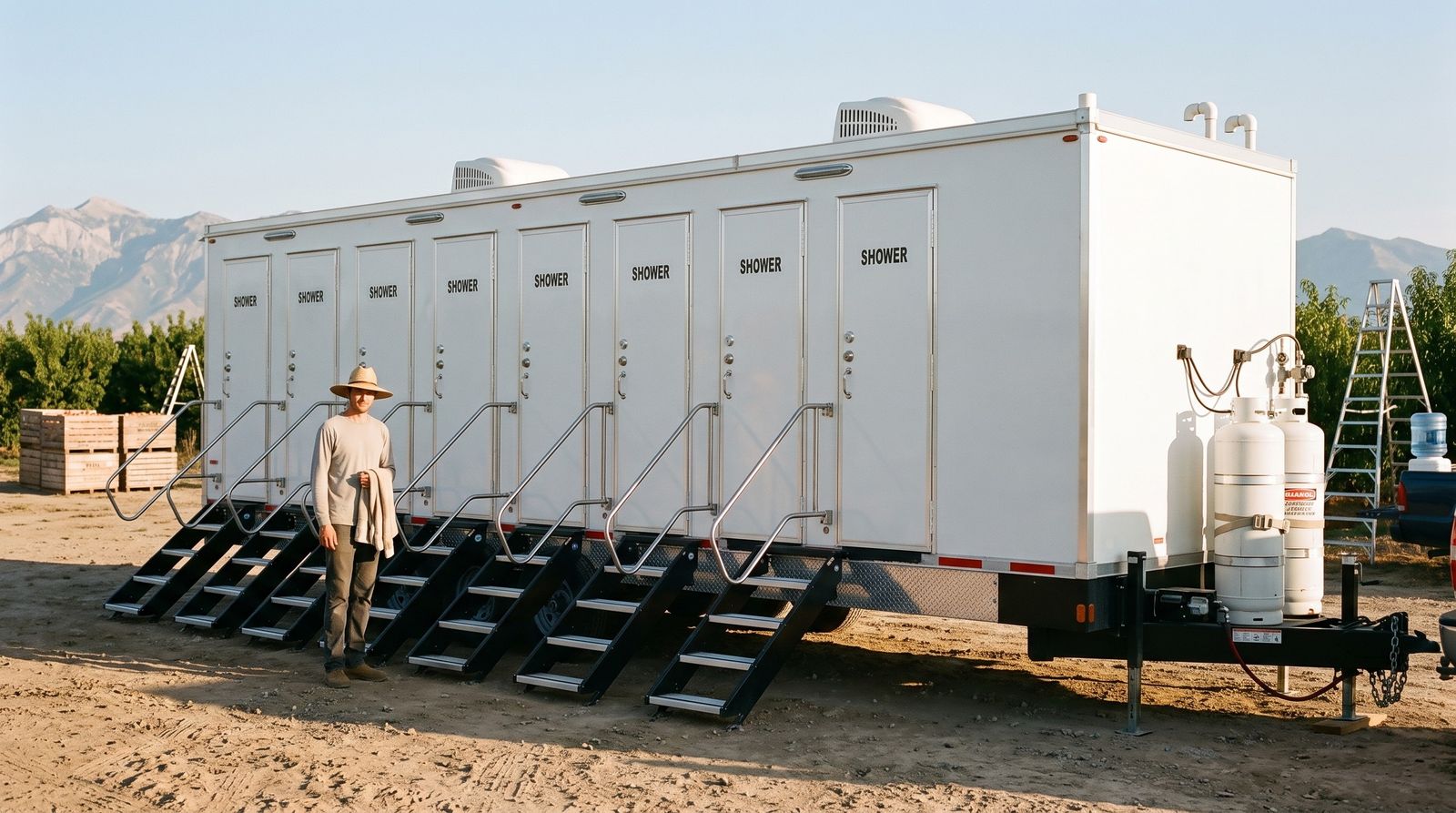
The planner on this page asks for the same things the call does, plus a few details that shorten the callback. It reaches the same desk. Use it when the details are still soft, when you are comparing options and want something in writing, or when it is late and you would rather not leave a voicemail.
It is also the better route when several people on your side own different pieces of the answer. Filling it in lets you gather the site details from whoever actually knows them rather than improvising on the phone, and it gives everyone on your end the same version of what was asked for.
Send it even with gaps. A request with four of six answers and a note saying which two are unknown is more useful than a delayed request with all six. The gaps become the first thing the callback covers.
For anything genuinely urgent, skip it. A facility with no hot water and a camp standing up this afternoon both need a voice on the other end rather than a queue. The number for that is (801) 683-5822.
What happens between your request and a delivery date
Requests that reach us while the desk is staffed normally get a reply before the end of that day, and anything that arrives after hours sits at the top of the pile the next morning. What comes back is either a plan with a number attached or two specific questions and then a plan, and the questions almost always land on the approach road or the electrical supply, since those are the parts nobody can judge from a written description.
The plan is not just a price. It says which unit, where it would sit, how it gets power, where the water comes from, where the waste goes, how often somebody comes back, and what the site needs to have ready before the truck arrives. On a winter or high altitude job it names the freeze protection and the snow clearing plan. On a public event it names the accessible unit and the route to it.
Once the plan is agreed, delivery is scheduled around your window rather than ours, and you get a day, a rough hour, the name of who is bringing it, and a short list of what needs to be clear when they arrive. That list is genuinely short: a clear approach, the pad free, and somebody on site you can reach.
Nothing is held on a soft yes. If the week you want is committed, you will be told that rather than left hoping. Stringing a customer along while waiting for something to free up wastes their planning time and usually ends with two unhappy jobs instead of one.
Who needs to be there and what they need to know
Somebody on your side should be reachable when the truck arrives, and ideally standing there. Not the gate guard and not a phone number that rings out. A person who can say where the unit goes if the marked spot turns out to be wrong, and who can take the walkthrough at the end.
The walkthrough is five minutes and it prevents most of the calls that would otherwise happen after dark. How the thermostat works. What the service schedule is. What the tank situation is on a self contained placement. Which number to ring, and for what. That person does not have to be the one who booked it, but they do have to exist.
If the approach turns out to be different from what was described, the driver will say so before committing the truck rather than after. Frequently there is a better spot a short distance away and the problem goes away once somebody has walked it. Occasionally there is not, and that conversation is much better had with the truck still on solid ground.
On accessible placements the route from the parking or gathering area gets walked rather than assumed. A compliant room at the top of a ramp that starts in soft gravel is not accessible, and that is a site preparation item as much as an equipment one.
Service calls and the things worth ringing about
If something is off, ring the same number. It reaches somebody who knows which unit is on your pad and what its service history looks like, so the conversation starts from the specifics rather than from a general troubleshooting script.
Call straight away if drainage has slowed or the hot water drops off. The same goes for a room that will not hold temperature or a thermostat nobody on site can work out. And call if the service road has changed since the last visit, like a road washed out in spring on the way into a Castle Valley site. Also anything that has changed on your side, like a crew that has doubled or a placement that is now running past its original window.
Small problems on day one are cheap to fix. The same problem on day four has usually already cost you the crew's confidence in the unit, and confidence is the thing that decides whether people keep using it. Nobody has ever regretted calling early about a slow drain.
In winter there is one extra item on that list: anything that suggests the freeze protection is not doing its job, or an access route that has drifted or iced over. We check UDOT's road conditions map for the highway part of the drive, but only someone on site knows what the last mile looks like. Those are same day calls rather than next visit calls, because a frozen unit is a much larger problem than a cold one.
Extending, shortening and moving rental dates
Plans move here, mostly around weather, and moving one is an ordinary conversation rather than a whole new negotiation. Extending a placement is usually straightforward with a little notice, and the notice matters more than the length: a week ahead is easy and the morning of the scheduled pickup is a scramble.
Finishing early just needs a pickup slot. The unit gets pumped and pulled and the pad is left the way it was found. Anything you put in or around it comes back to you rather than into the truck.
A change in usage is worth flagging even when the dates hold. A crew that has grown, a shift pattern that has shifted, an event that sold more tickets than planned. Those change the service cadence, and adjusting it before the tank tells us is considerably better than after.
Moving a placement to a different spot on the same site is usually simple. Moving it to a different site is a new delivery with its own access questions, and it is worth treating it that way rather than assuming that because one pad worked the next one will.
The three roles a rental needs filled
Rentals go smoothly or badly largely according to whether three jobs on the customer's side are clearly owned, and they are frequently three different people.
The first is whoever is arranging it. That person holds the dates, the headcount and the budget, and they are usually the one who rings. They do not need to know what circuit is behind the building, and pretending to know is where most of the trouble starts.
The second is the site contact: somebody who is actually at the location, who can answer what the ground does when it rains, who knows where the power comes from, and who will be reachable on delivery day. On a construction job that is often a superintendent. At a venue it is often the grounds crew lead rather than the coordinator. On a production it is usually a locations person. Naming that individual at the point of booking is one of the highest value things a customer can do.
The third is whoever will notice if something is wrong during the placement and ring about it. On a short event that is the same person as the second. On a long crew placement it needs to be somebody who is there every day, because a slow drain that everyone assumes somebody else has reported stays unreported for a week.
Where one person is doing all three, say so and we will pace the questions accordingly. Where three people are involved, give us the names and the numbers at the start and nobody spends delivery morning trying to find out who has the gate code.
The small details that decide the delivery
Some of what gets asked on the call sounds beside the point and is not, because these are the details that have caused real problems often enough to have become standard questions.
Who clears the snow, and when. On any winter placement that is not in a maintained lot, somebody has to clear the pad and the approach, and the correct time to settle who is before the unit arrives rather than after the first storm. A unit that cannot be reached by a service truck stops being serviced, and in February that is a fast route to a frozen line.
What the gate situation is. Codes, keys, hours, whether there is a guard, and whether a delivery outside normal hours is even possible. A production with a night call time and a venue with a locked gate at six can both be solved and neither can be solved at seven in the morning on the day.
Where the unit sits relative to people and cameras. On a production it needs to be out of the shot and out of the background of the shot. At a wedding it wants to be close enough that people will actually walk to it and far enough that it is not in the photographs. At an event it needs to be somewhere the service truck can reach without crossing a pedestrian route at the worst possible hour.
What else is on the circuit. Not whether there is power, which everyone answers yes to, but what else comes on in the morning. This is the single most common cause of a nuisance trip on a job site, and it is completely avoidable with one question.
Wind exposure and orientation. An open bench, a ridge or a playa site loses heat around doors and takes dust in through seals, and turning the unit ninety degrees sometimes fixes both. It costs nothing to think about at placement and cannot be fixed later without a truck.
And quiet hours, noise limits or generator restrictions, which venues and some municipalities have and job sites usually do not. A generator that cannot legally run overnight changes the whole power plan, and it is far better known in advance.
Before you book a trailer you have not stood in
There is no showroom. The trailers are on job sites, at venues, or in the yard being turned around between rentals, which is where equipment like this belongs. If you want to see one before booking, ask on the call and we will work out whether there is a unit accessible in a useful window.
The Utah shower trailer interior walkthrough covers the inside of a unit end to end, which answers most of what people actually want to see: the rooms, the vanity side, the finish. We can also send photographs of the specific unit that would come to you rather than stock images of a different build.
If you are weighing this against a row of standard portable units, it is worth seeing the rooms rather than reading about them. It is the reason usage rates differ so sharply between the two, and usage is the only measure that matters once the rental is paid for.
Pickup day and the site after the rental
Once the unit leaves, the pad should look like it did before it arrived. Blocking and skirting come out, anything that was brought in goes back on the truck, and the spot is left clear. On a site that is going back into use immediately, that matters more than it sounds.
If the placement is going to repeat, next season's booking is easier because the site is already understood: the access, the surface, the power situation, the service route, what the ground does in spring. Repeat placements tend to be the easiest jobs on the calendar for exactly that reason.
And if something about the rental was not right, that is worth a call after the fact rather than a quiet decision not to ring again. A short, specific complaint is more useful than almost anything else, and it is the only reliable way any of this gets better.
For everything above, the line is the same: (801) 683-5822.